How to Create Facebook Ad Sets for Book Marketing
Now that you have created a campaign that sets the goal of running your ads, think of ad sets as the folder where you set "WHO" your ads show to.
It can be a place where you group ads, but its main purpose is actually just targeting settings. This is where you control:
- Geography
- Interests
- Targeting people in your email list or who have visited your website
- Age
Ad Set Structure
My current setup and recommendation is to have one ad per ad set.
Let me explain why. To be successful with ads, it is really important you:
- Test many ads
- Test each ad extensively
Testing Ads Extensively
If you spend $3 on an ad, you didn't test it enough. If you spend $100 on an ad in one day, you didn't test it enough. You need to test an ad for 10+ days.
Why? Facebook needs time to optimize who it's showing that ad to.
Your ad set will have broad targeting if you're using Advantage+. You probably have 30 million people it could show to. Are all of those the best readers for you? Probably not.
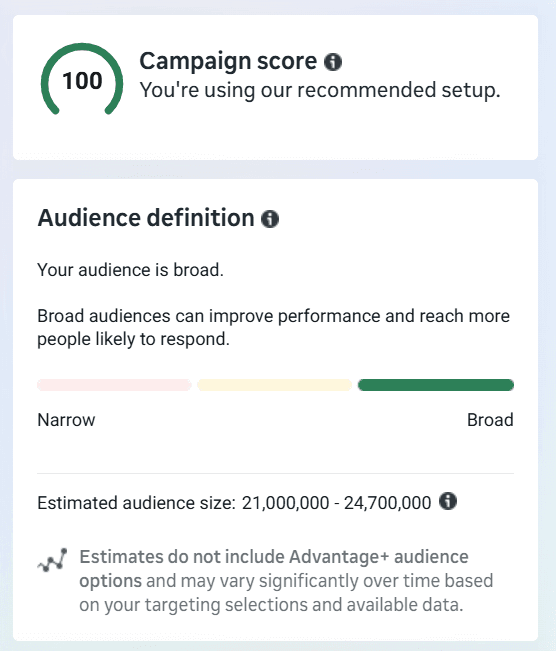
So Facebook will show it to random people, who are generally close to your ideal reader, in the first 2-3 days.
Then it will say, "Hey these 50 people clicked on this ad, they have these 3 things in common. Let's show other people with those 3 things in common the ad." Now this might only be 300k people.
Then your ad performance will start to pick up.
Now more of your ads will go to the right people. Facebook will still show it to new audiences, they're trying to find creative pockets of people interested in it.
So you have to test the ad extensively. Also, book sales are cyclical. People change their reading behavior on the weekends. So if you only test on a Tuesday, you might be missing out on Saturday performance. I find Sunday to be the best day and Friday/Saturday to be the worst for romance book advertising.
My Recommendation
Take the budget you're willing to test on one ad and divide it by 14. That's your daily ad set budget.
I use $3. I'm willing to spend ~$30 per ad test over a 10-14 day period. By then I can be confident an ad will or won't work.
Testing Many Ads
Now that we've established an ad testing strategy, let's consider that we are running a whole portfolio of ads.
We may want to test several ads at once. Or, most importantly, we need to balance testing new ads and spending on ads that we know work.
If I create one ad set with my targeting, and put all of my ads into it, you will run into 2 problems:
1. With Traffic Campaigns, Facebook doesn't optimize correctly
If you're running a traffic campaign linking to your book on Amazon, Facebook doesn't have actual sales data. The only thing it can optimize for is the lowest CPC.
But what's actually important is the return on investment for your ad spend. For paid ads, this is called ROAS.
You need to either use AdSync or a spreadsheet to link your Facebook ad spend and Amazon Attribution data. There you can see how many royalties you got per ad.
There are a lot of scenarios where a higher CPC ad actually drives more royalties. When you see this in AdSync, then we need to make sure we're turning off losing ads in Facebook and scaling the winning ones.
$100 ad spend, $80 in royalties, $.10 CPC
$100 ad spend, $150 in royalties, $.12 CPC
But if I have many ads in each ad set, I can't control the ad budget for each individual ad. This is the main reason I run one ad per ad set, greater control of your ad budget.
If you're running a sales campaign to your Shopify website, Facebook will have your pixel data and this is not as much of a problem.
2. Facebook will only spend budget on 1 ad per ad set
I have found that if I put multiple ads in an ad set, Facebook picks one and runs all the budget to it.
When I first started I would run "test bundles" and create 5 new ads and give Facebook a $20 a day budget. Well, I found that 90% of the budget gets spent on 1 ad, even if that ad isn't the lowest CPC (and certainly not the highest ROI as facebook doesn't have the sales data for traffic campaigns).
So I could turn the ad off after 2 days and $40 in spend. But then I haven't correctly tested my ad.
Remember we want to test ads over a period of 10-14 days to get the most representative results.
I've never found an answer online, but I do know that ad set budgets are working better for testing.
3. Easier to manage changes
Finally, this structure makes it easier to make changes down the road.
Changing one ad or ad set only sends that ad into the learning phase, not all of your ads in the ad set. By keeping them separate, you isolate the impact of any changes.
Ad Set Naming
Ok, so now you know I recommend 1 ad per ad set. This will lead to a scenario that looks something like this:
This is how I'd recommend naming your ad sets. You will have 1-2 testing ad sets, and an ad set for each ongoing winning ad. Just name them so you can tell the ad in it, and if it's a winner or testing.
There are some other distinguishing factors you might include in the name:
- Geography: Ad sets are where you can target by geography, so if you're advertising to different countries this is where to do that and differentiate it in the name.
- Advanced Audiences: This is an advanced technique, but if you're not using interest based targeting (aka a user likes romance or sci-fi) but rather targeting lookalike or custom audiences (like your email list) you can create a separate ad set for that.
Conversion
You'll choose "Website" and for the performance goal you want to "Maximize the number of link clicks".
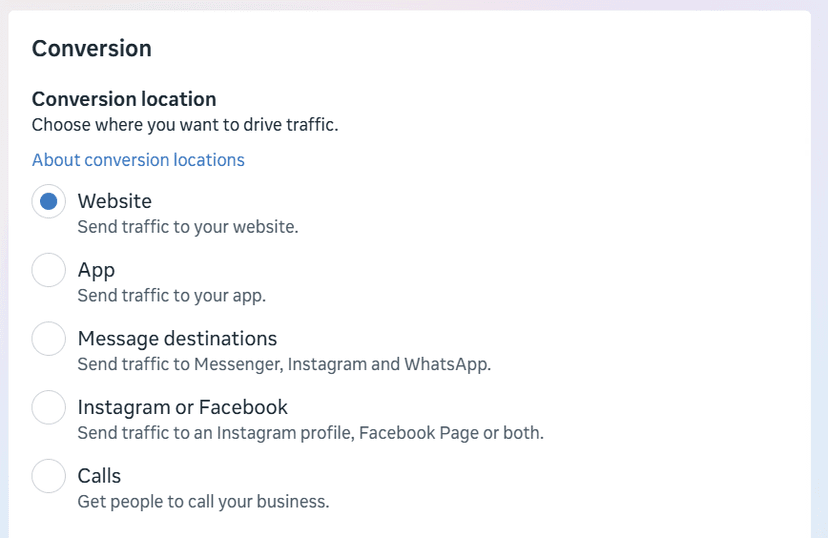
You can leave the rest of the settings as default here.
Budget
I set my ad set budget here.
I use $3 a day for initial testing. That's pretty low. You could go as low as $1.
I do that because I'm testing 3-4 ads at once and because I want to spend $30-40 over the lifetime test of the ad ($3 for 10-14 days).
I don't set an end date. Turn the ad off manually when you're done testing it. If you set an end date, it will impact how Meta shows ads and skew your results.
Audience Controls
These are the most precise audience controls you get. Mainly put in place for legal reasons.
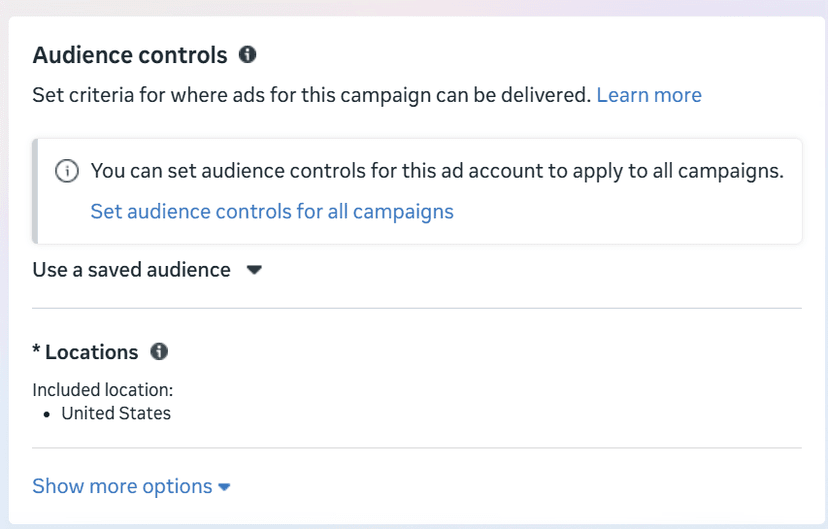
Your minimum age should be 18 (you can go lower if you're young adult, but just make sure you're familiar with the ramifications of advertising and selling to minors).
Choose your geography here. You can filter on language if you'd like.
Advantage+ Audience
In the distant past, before changes to Facebook ad algorithm in 2025, picking the interests and narrowing down your audience was seen as the most important part.
Do not rely on that now.
Facebook is set up to use advanced math to determine who to show your ads to. They will do a really good job at seeing who engages with it and showing it to more people like that.
If you do a manual campaign set up you can force Facebook to be very specific. However, you can also opt-in to Advantage+ detailed targeting, which is what I do and recommend.
If you've chosen "Recommended setup" and are using Advantage+ Campaigns, you are forced to use Advantage+ Targeting. What this is doing is "suggesting" where Facebook look when they're starting to test your campaign. They will use this info, as well as their own analysis of your image and text, to determine the first several thousand people who see the ad. After they test that and learn, then they will tailor the audience further to who likes seeing your ad.
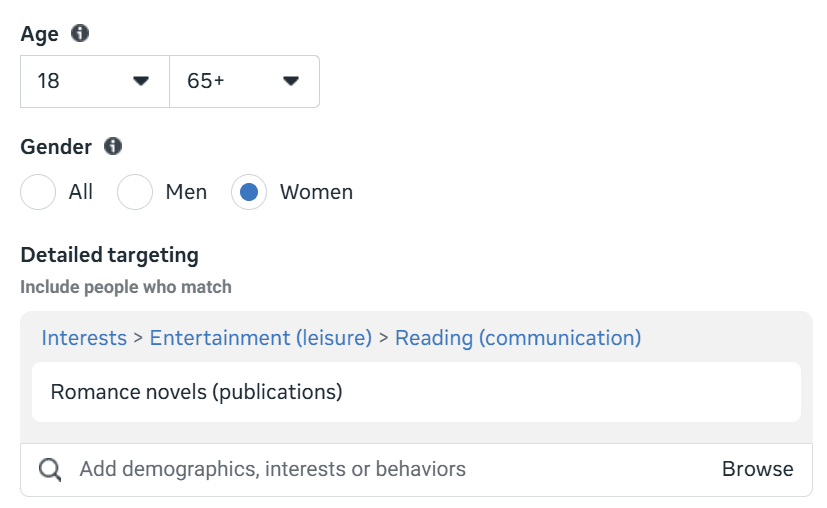
I do add 4-5 interests, but it's pretty broad. "Romance books", "e-book readers" etc.
Placements
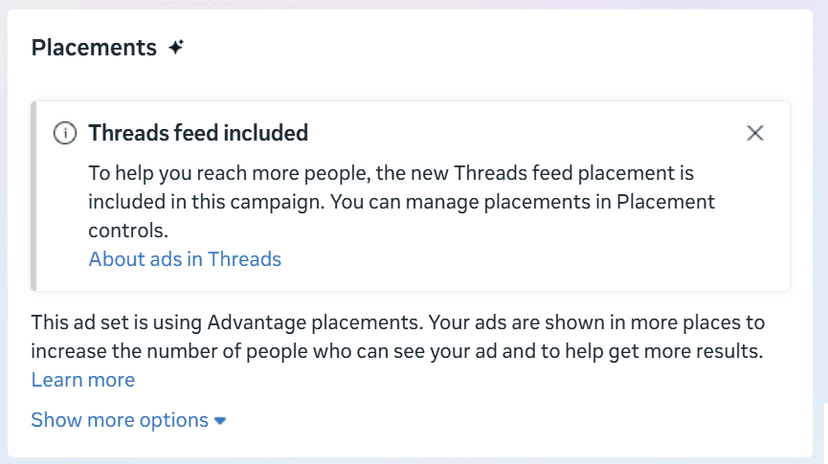
Enable all placements (Advantage+ Placements as it's called in manual campaigns), don't waste your time worrying about this.
95% of your impressions will go to Facebook feed, reels, stories, and Instagram feed anyways.
Conclusion
Hooray, you've gotten through the most confusing part. The campaign and ad set are pretty abstract and specific to Facebook.
That being said, the important part is still in front of you, so you're not out of the woods yet.